Story by Graham Gauld
Everyone remembers that the first Le Mans race held after WWII was in 1949 and was won by Luigi Chinetti and Lord Selsdon driving a Ferrari barchetta. Usually that is where everyone’s recollections end; but that Le Mans race was fascinating not just as a spectacular event to take our minds off post-war austerity, but for some of the cars taking part.
For example, one of the iconic sports cars of the 1950’s, greatly favored by British drivers because of its performance, was the Frazer Nash Le Mans Replica. So why would anyone buy a “replica”? The reason is simple: the prototype of that car was entered by the Frazer Nash company as a Frazer Nash HS – for High Speed.
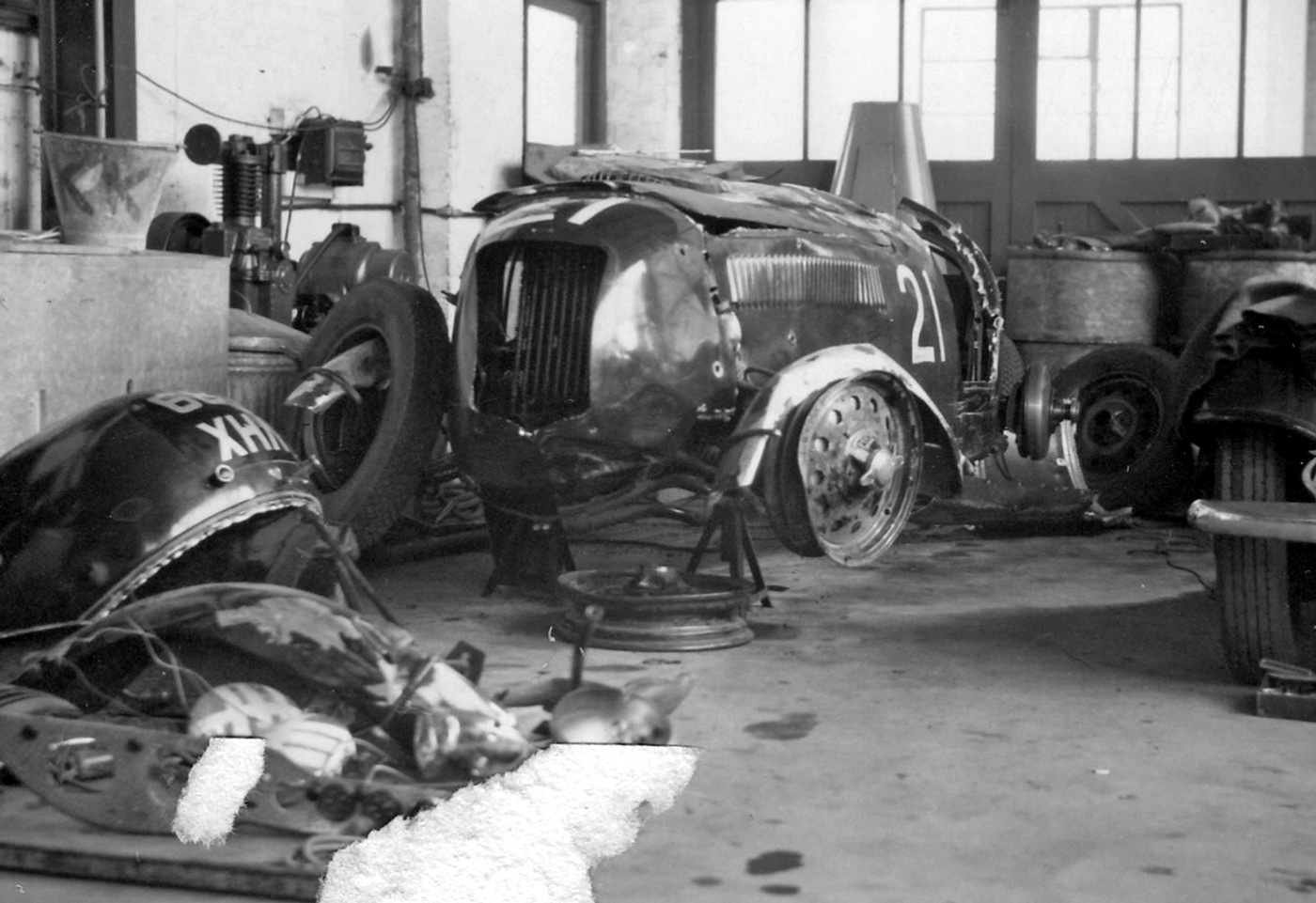
The Frazer Nash Le Mans Replica after Roy Salvadori’s near-fatal accident at Silverstone. (Tony Crook archive)
Much to everyone’s surprise the car, driven by Norman Culpan and H.J. Aldington, one of the brothers that owned Frazer Nash, finished third overall after the Ferrari and Henri Louveau’s Delage D6RS. When they went into production with this cycle-winged sports car, the factory called it the Le Mans Replica in respect of their podium result. Amongst many British drivers who bought them and came to everyone’s notice driving them were Roy Salvadori and Tony Brooks.
Successful though they were, they later gained a bad reputation for killing people. Roy Salvadori came close to becoming one of them after a high-speed accident at Silverstone when the car rolled and was almost destroyed. Another Frazer Nash driver, Tony Crook, collected the remains of Salvadori’s car and took it back to his garage. When Roy was given the last rites in hospital everyone thought that was that, but in fact he miraculously recovered and came back to a stellar career in sports cars and Formula 1.
Then there was the Aston Martin DB1 coupe that finished 7th and the DB1 Spyder that finished 11th at Le Mans that year. This encouraged David Brown to go into serious production of the DB2 Coupe which heralded in Aston’s post war successes.
And how about the two Aero-Minors that finished 15th and 19th in that 1949 race. What about them, you may well ask?
Bearing in mind the year and the continuing chaos in Europe, those two Aero-Minors were built in Soviet-controlled Czechoslovakia by the Jawa company which had been founded in Prague in 1929 by František Janecek.
Janecek got his start thanks to the 1929 Depression when the German bank sold off the motor cycle division of the Wanderer car company in Germany. (Wanderer later became a member company of Auto Union). Janecek then set up business as Jawa using the first two letters of his Christian name and the first two letters of Wanderer!
Jawa motor cycles became successful they began work on a small car, but when WWII came along, the work was stopped, but a small group continued with the plan to use the Jawa 600cc two-stroke motor cycle engine car, despite the German occupation. It is said they told the Germans the car was a BMW development, and they were even able to test prototypes before the war ended and so were up and running in 1946.
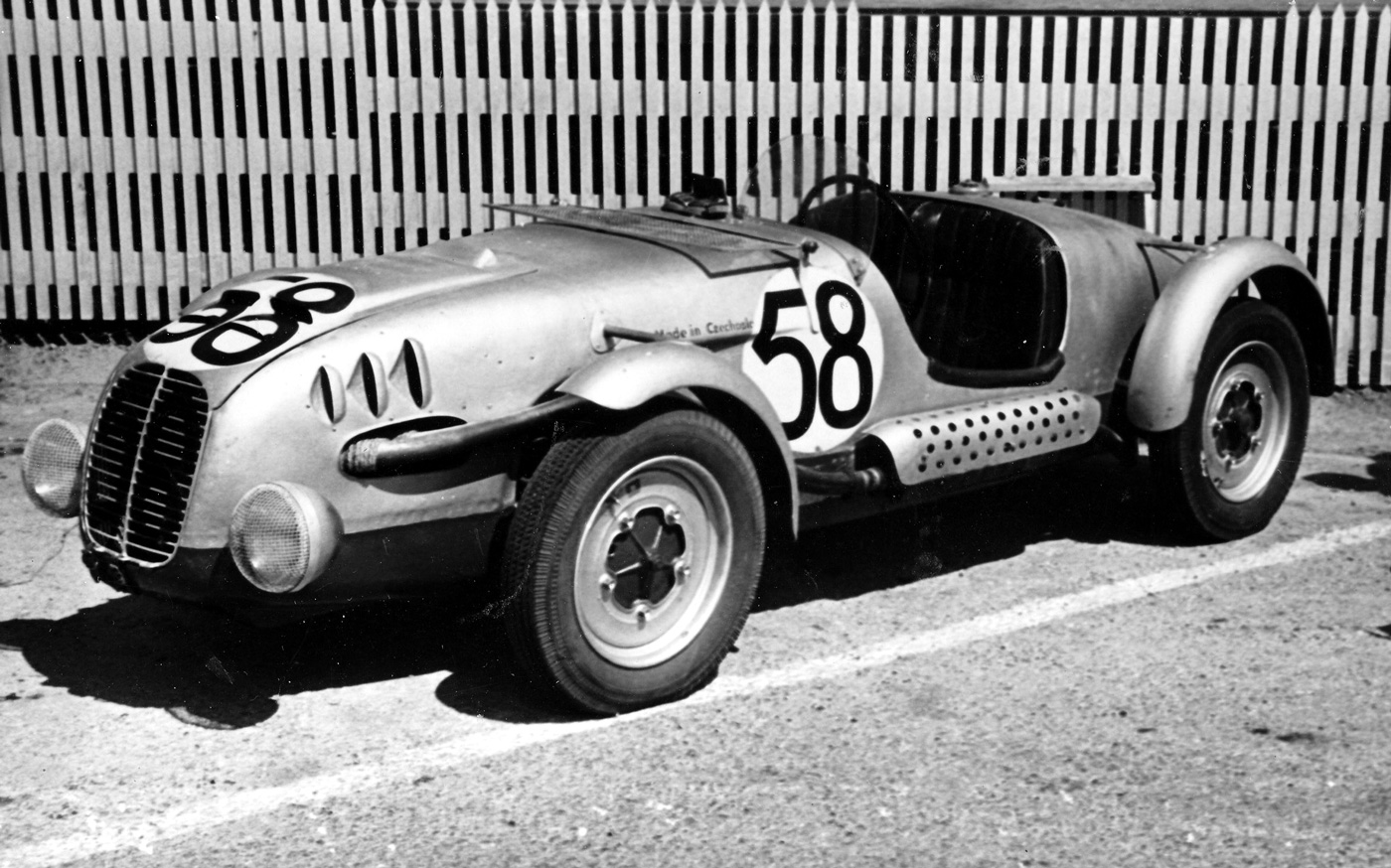
The Czech Aero-Minor at Le Mans in 1949, the Class winner.
The Aero-Minor had front wheel drive and was a pretty ordinary looking sedan. But, they decided to build a couple of lightweight sports cars to compete at Le Mans in 1949 and duly turned up with two torpedo-like designs with cycle wings and driven by Otto Krattner and Frank Sutnar in one and Jacques Poch and Ivan Hodac in the other.
Both cars ran in the 501-750cc class with engines increased to 745ccs. The Krattner car was the more successful, winning the class ahead of the 500cc Simca 6. Nearly 300 kms behind the winning Aero-Minor was the other Aero-Minor, which finished third in class. A year later, in 1950, the Aero-Minor won its class again at Le Mans this time driven by the seasoned Dutchmen Maurice Gatsonides and Henk Hoogeven which took the 501-750 cc class.
There is an interesting footnote to the Aero-Minor story. Just before Christmas 1949 Josef Stalin, the Russian leader, was presented with one of the Aero-Minor sedans as a gift. As Stalin had an interest in being given models of cars from countries he had taken over after the war, he also was given an EMW ( the model built in East Berlin based on BMW mechanicals), and examples of other Czech makes such as a Tatraplan and a Skoda.
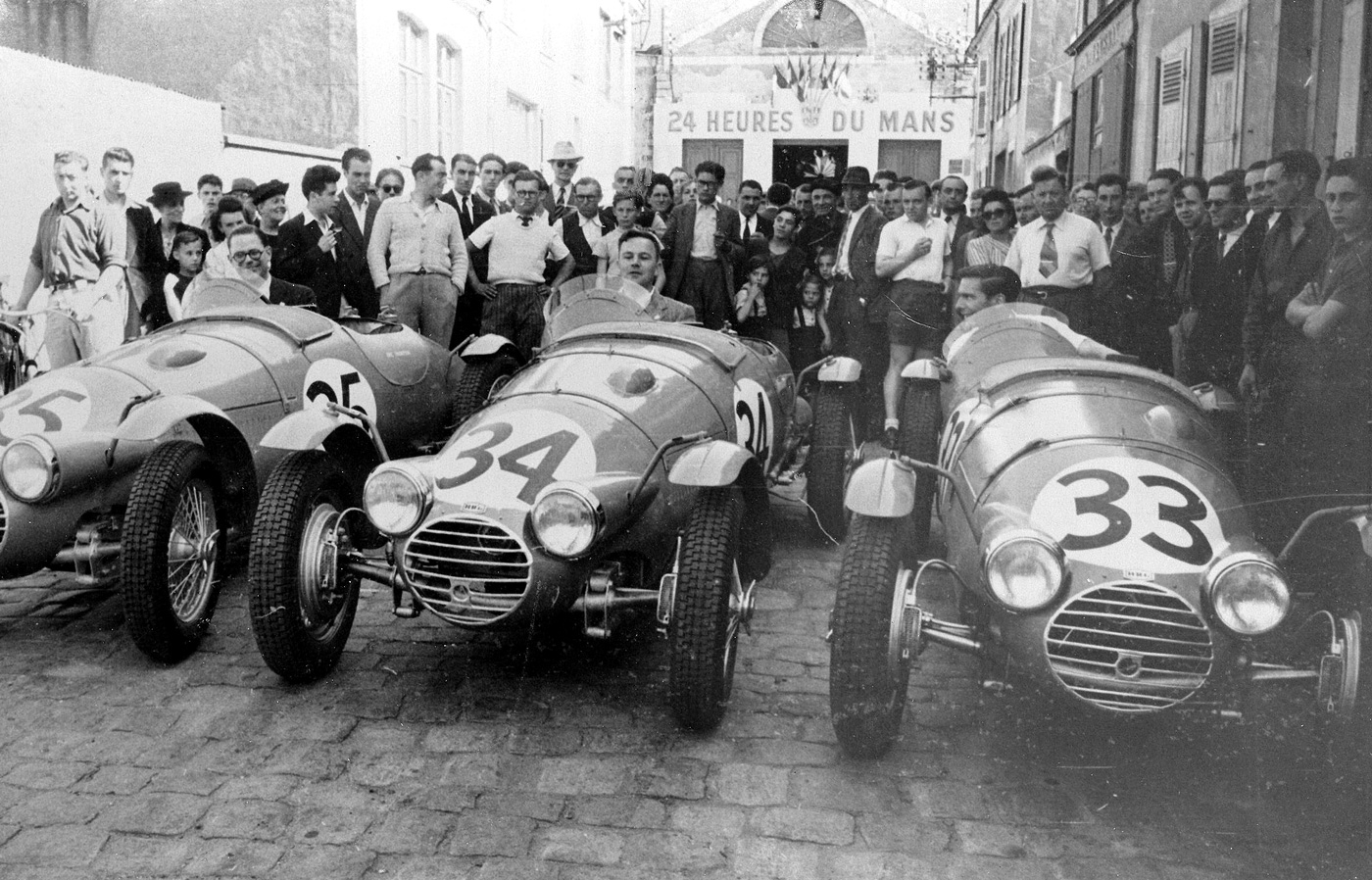
The HRG team for Le Mans 1949. On the extreme left is the Class winner. ( Gordon Wilkins)
Finally, there was a factory team of HRGs taking part at Le Mans 1949. HRG was founded in 1935 by three partners, Major A.E.(Ted) Halford, Guy Robins and Ron Godfrey, who built their first sports cars using Meadows engines. Godfrey had split from his original partnership with Archie Frazer-Nash. The cars were successful and by the late 1930’s they were using Singer engines which continued after WWII.
However, for Le Mans in 1949 they came out with three sports models with smaller bodies and lightweight cycle wings with the hope of winning the competitive 1100cc-1500cc class. They gathered together a good team of drivers led by Lloyd’s banker Eric Thompson and Jack Fairman, Peter Clark and “Mort” Morris-Goodall, and Jack Scott with Neville Gee, but their Le Mans was not only bitter but sweet. The Clark-Morris-Goodall car was out after just three hours with a smashed radiator. If one looks at the needle-nose on the car one wonders if the radiator was getting sufficient cooling anyway.
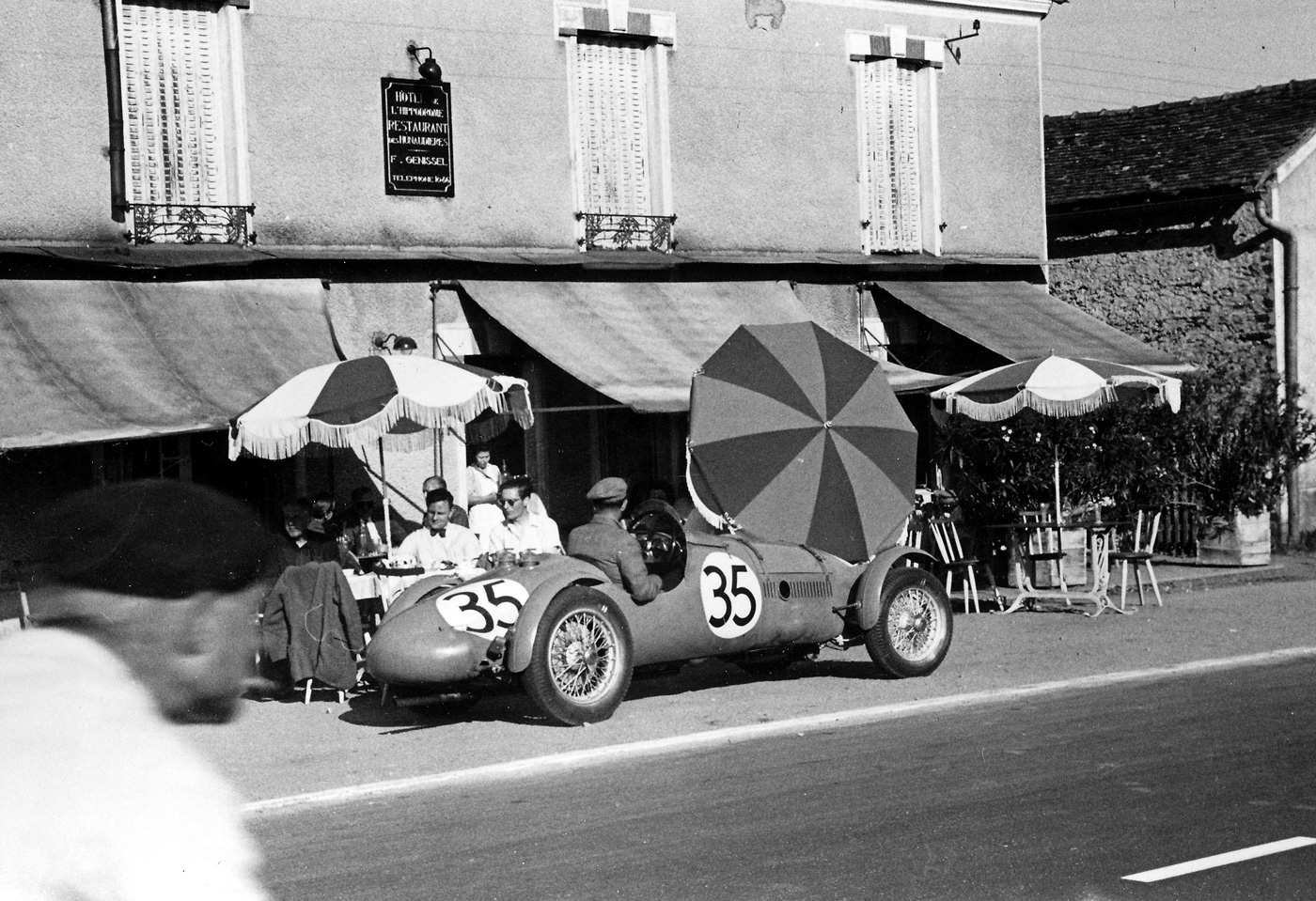
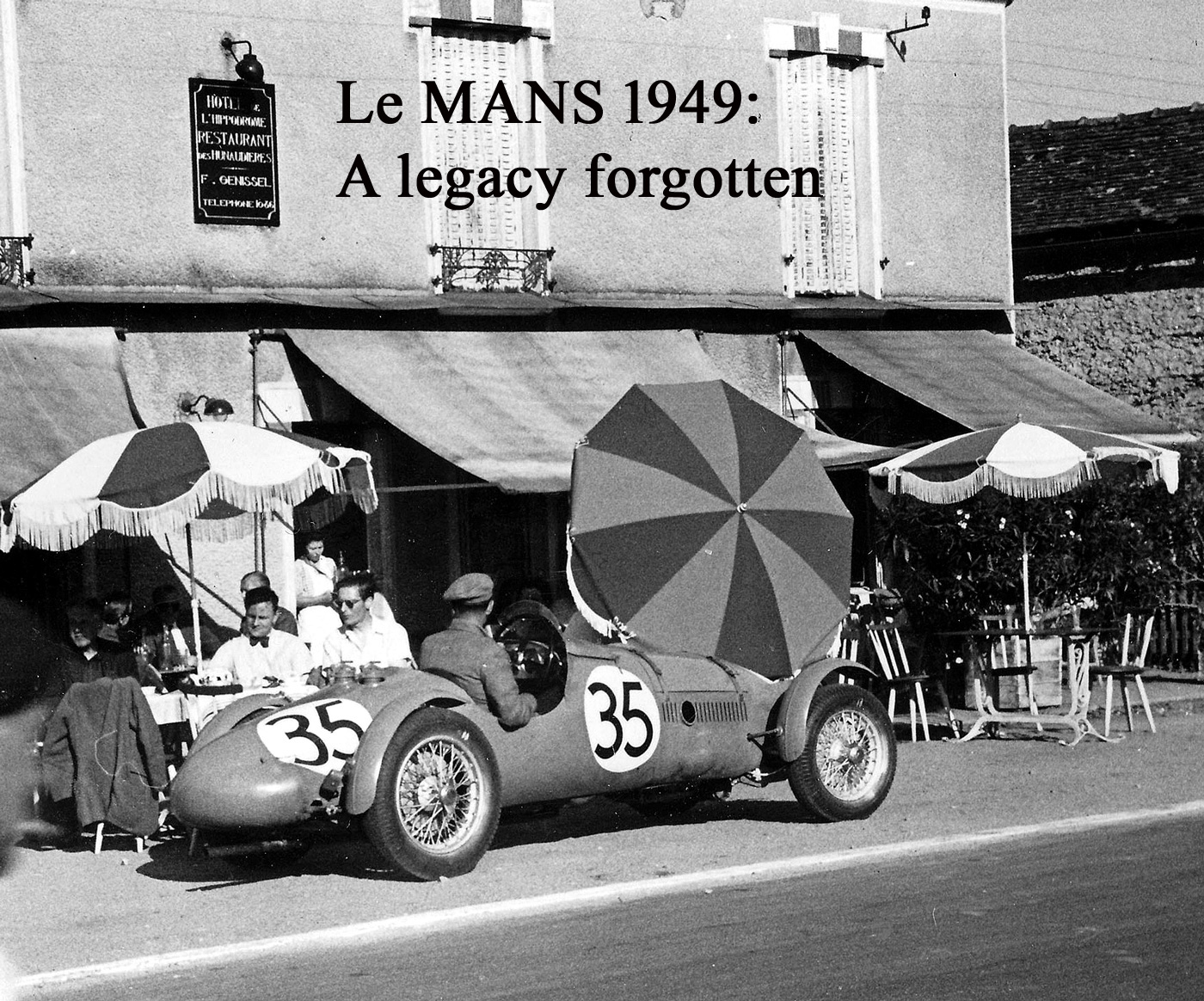
After practice for the 1949 Le Mans one of the drivers motors back to the Hunaudiers Café on the Mulsanne Straight for a quiet drink ! (Gordon Wilkins)
Then after thirteen hours the Scott/Gee car also went out with engine trouble but the cool and calm banker, Thompson, and the more ebullient Fairman not only finished 8th overall but won the 1100cc to 1500cc class by over 300 kms from the next car in the class, a Simca 8. Eleven years before, at Le Mans 1938, Peter Clark and Marcus Chambers had won the same class in one of the standard Singer engined HRGs.
So the next time someone asks about Le Mans in 1949 think for a moment on these other cars, which in some cases led to future glory.
Delahaye was there at LeMans in 1949 too, fielding seven cars. Five were 3.5 and 3.6-liter prewar ‘Competition Court’ sports-racing Type 135 cars, and the other two were the “New Delahaye Type 175” purpose-built sports-racers. Both of them were prewar Delahaye racecar chassis, that the company re-engined with its race-prepared 4.5-liter Type 175 motors. Both chassis were rebodied in the new postwar style by French coachbuilder Valtat. These visually “new” Delahayes were campaigned under Charles Pozzi’s and Eugene Cabaud’s new postwar racing team: Ecurie Lutetia’s banner. Andre Simon set the track record in Pozzi’s car, but neither entry finished the race. Pozzi’s car was retired from overheating issues in the 19th hour; and, Chabaud’s retired because of suffering an electrical fire. Both cars reappeared in the 1950 LeMans race, in unchanged form, but again they failed to finish.
I never knew the origins of Jawa . I’m quite familiar with the motorcycles and with Auto Union but was unaware of the shirt tail relation of Jawa via Wanderer and was totally ignorant of the Aero-Minor. Thanks for the info.
Love the Aero-Minor!