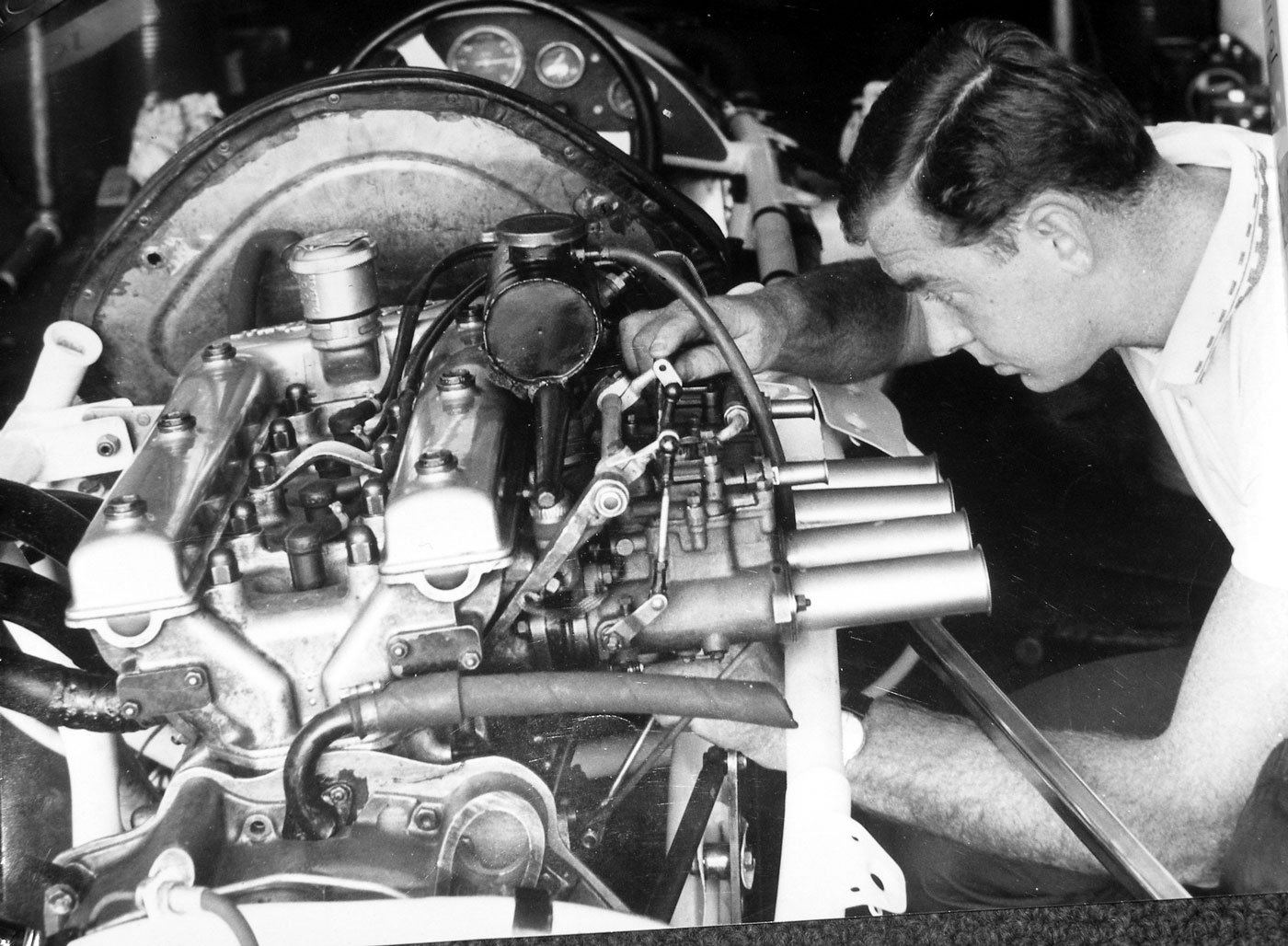
Bruce Johnstone inspects the motor. (Photo: Tony de Wijn)
Story by Robert Young
In the late 1950s, after years of austerity following WW2, as motor racing became more ‘professional’ in South Africa and factory-built racing chassis began to take their place on the grids and displace the ingenious ‘specials,’ the drivers sought the cheapest and most efficient engine power.
The 1½-liter South African Formula One Championship from 1960 to 1965 up to the adoption of the 3-liter formula was notable for the use of Alfa Romeo power for many of the contenders. Contrary to popular opinion these engines were not imported racing motors but were self-modified by the resourceful locals.

Syd van der Vyver. Master tuner. (Photo: Anne White)
Syd van der Vyver instigated the use of Alfa power. In early 1959 he acquired a 1957 F2 Cooper Mk. II and fitted a self-modified 1290 cc Giulietta engine and put up encouraging performances against the Porsche 550A Spyder of champion driver Ian Fraser Jones and the visiting British drivers Dick Gibson and Keith Ballisatt in their more modern 1½-liter Climax powered Coopers.

March 1959 – Easter Motor Races at Pietermaritzburg was the debut of Syd’s Cooper using 1290 cc engine. He placed second to Keith Ballisat’s Cooper-Climax in the 45 lap Coronation ‘100’. (Photo: Lew Baker)
With a 1½-liter championship in place for the 1960 season Syd bored his motor to 1475 cc and following his impressive showings, a number of other local drivers who had imported factory built Cooper chassis, many of them well worn, sought to use Alfa power.
In European F1 and F2 there was little evidence of Alfa power among the single-seaters and the question was why had the South Africans gone for Alfas instead of the ubiquitous Climax FPFs.
Cost was the primary factor. There was an Alfa Romeo assembly plant at East London and the speedy Italian saloons and sportscars had become popular with motoring enthusiasts, so spares were easy to come by. “Peter de Klerk, who fitted the engine to Syd’s Cooper told me that it arrived brand new in a wooden crate,” remembers his great friend Lew Baker. Used parts could be obtained from the scrapyards as inexperienced and over eager drivers of the fast little cars were involved in accidents. Furthermore, there was an availability problem for Climax parts and then delays due to shipping. In addition, there were the punitive import duties and moreover import permits were difficult to obtain at a time when the country was seeking to restrict the outflow of currency.

Peter de Klerk
It ended up a good choice because the Alfa production engines proved to be extremely robust, developed competitive power and were amazingly reliable. Lew Baker recalls, “It was not only the top drivers who had businesses or some form of sponsorship such as free fuel and oil or discounted tires but those impecunious back markers who chose the Alfa route. For instance, Bill Dunlop was a linesman for the electricity corporation and ‘Sparky’ van Popering was a salesman for an industrial supplier company. ‘Sparky’ absented himself from work to go racing when he should have been selling merchandise. At times Alfa powered machines made up some 50% of the fields. There is no way these enthusiasts could have afforded to race if not for the cheaper Alfa Romeo power.”
Landmark event
The Sixth South African Grand Prix at East London on New Year’s Day of 1960 was a landmark event and attracted several foreign drivers including Stirling Moss and Chris Bristow in Cooper-Borgwards, Paul Frere and Lucian Bianchi on ENB Coopers and a handful of privateers.
During late 1959 Syd imported a special Conrero modified Alfa Romeo engine specially for the grand prix. It was the first that Conrero had bored out from 1290 cc to 1475 cc. However, he found that this engine was less powerful than his own self-built engine, but after modifying it he was able to extract a few more horsepower. He decided to use the Conrero engine for the grand prix but during practice the motor ‘blew-up.’ Syd’s mechanics, Peter de Klerk and Pat Phillips sped back to his Durban workshop on an overnight return trip 400 miles away, to collect his old engine and other parts in order for a motor to be built for the race. This trip was a race in itself. Driving almost entirely at night they covered over 800 miles in twelve hours on single lane country roads in a 1290 cc Guilietta.

Cooper Mk. IVs in the lead. Moss takes the lead from Frere and Bristow. Syd is #12. (Photo: Frank Hoal)
Late in the race Moss’s Borgward faltered and Frere slipped by to take a dramatic victory but Syd finished third, on the same lap as the leaders after 150 miles.

Van der Vyver speeds to third place in the grand prix. (Photo: Tim Cooke)
After this outstanding performance the Cooper-Alfa won 6 events on the local calendar to win the 1960 championship. In addition Syd won the Rhodesian Grand Prix.

Syd on his way to winning the 1960 Rhodesian Grand Prix. (Photo: Mannie de Villiers)
At the end of the year Syd upgraded to a new Lotus 18 chassis into which he installed an Alfa Romeo motor. The trusty old Cooper-Alfa was acquired by his serious rival Bruce Johnstone and driven to such good effect that Bruce was denied the 1961 Championship, won by Syd, due to a puncture at the last championship round. In the hands of Johnstone the amazingly reliable powerplant achieved three wins and four second places during the championship.
To give some idea of the reliability of the engine the championship races were between 70 and 100 miles whereas the international year end grands prix were between 150 and 200 miles.

1961 Natal Grand Prix at Westmead. Syd was fifth behind the Lotuses of Clark and Moss and the Porsches of Bonnier and Barth. (Photo: Anne White)
The Lotus 18 had made its debut in the season ending series of four grands prix and the 41 year old driver placed 7th, 5th, 6th and 7th in the Rand Grand Prix, Natal Grand Prix, South African Grand Prix and Cape Grand Prix. This against the ‘works’ Lotus and Porsche teams and teams from Parnell and UDT Laystall.
During the series, involving a race a week at tracks many miles from each other, after 1000 mile traveling tows there was not much time for maintenance and the engine completed 292 racing laps with little or no attention to its innards.
When Johnstone left South Africa to race in Europe and join BRM he sold the Cooper to Adrian Pheiffer who surprised all by his pace in the 1961 year end series of four grand prix.

1961 South African Grand Prix. Pheiffer was very competitive in the old T43 and was among the quickest of the local drivers and the engine totally reliable. (Photo – Mr Ferguson)

1961 Rand Spring Trophy at Kyalami. All Alfa front row. Johnstone, van der Vyver and Pieterse. Pieterse would win from John Love’s Cooper-Maserati. (Photo: Alton Berns)
Next: 1962 and other formulae