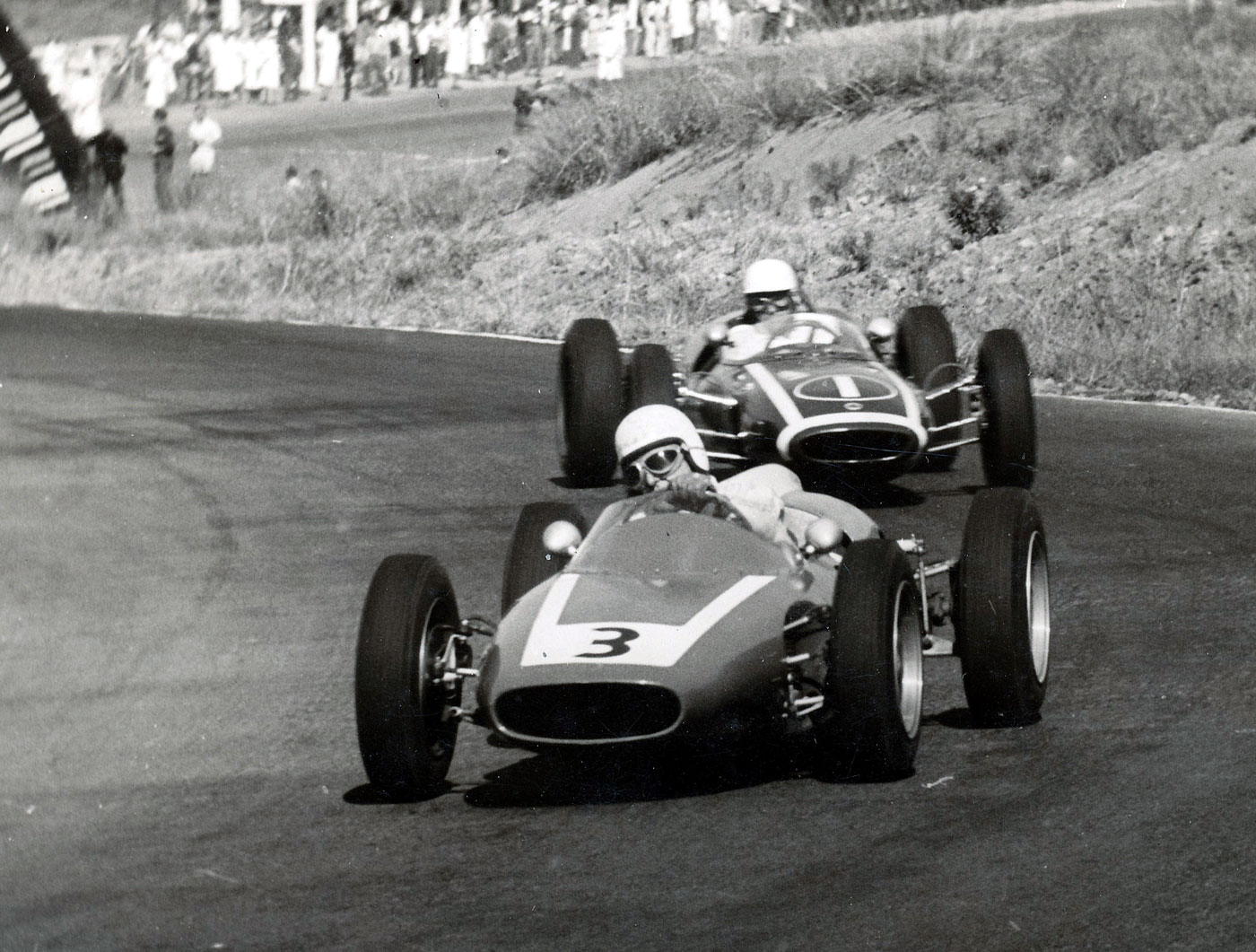
1962 Westmead ‘120’ – the first win for an LDS. Serrurier leads van der Vyver’s Lotus 21 Climax. (Photo: Tony de Wijn).
Story by Robert Young
The 1962 South African Grand Prix season would also be see successful Alfa powered racecars. Ernest Pieterse, a proprietor of an Alfa Romeo dealership engaged Peter de Klerk to assist with the fitting of Alfa power to his championship winning Heron.
The South Africans were adept at building ‘specials’ and Doug Serrurier of LDS fame, a close friend of van der Vyver and de Klerk, used Alfa power in his early constructions. “Pure racing parts were hard and expensive to come by and I remember that to make larger valves Doug modified Model T Ford valves in his engine,” recalled Lew Baker.

Watercolour of the Alfa Special by Andrew Embleton.
By 1962 Pieterse and van der Vyver had purchased the ‘works’ Lotus 21 Climax but the ‘Alfa cause’ had not died. Peter de Klerk constructed his own car. Simply called an Alfa Special and he developed it to such an extent that he finished third in the championship.

De Klerk leads the LDS-Alfa of Sam Tingle during the Daily Dispatch Trophy at East London. This event was a ‘curtain raiser’ to the South African Grand Prix. De Klerk won the race and set quicker times than some of the foreign cars accepted for the grand prix. (Photo: Ann White)
The following two years he was runner-up to John Love’s Cooper T55 but it should be noted that he did not take part in all championships rounds due to his commitments to the Porsche factory team where he placed sixth at Le Mans.

1963 Rand Grand Prix at Kyalami: Peter harries the Ferrari of Lorenzo Bandini thru the Leeukop Bend. He finished third. (Photo: Len Konings)
Horsepower Race
How quick and powerful were these home-tuned production car based powerplants?
The benchmark 1500 cc engine at the time was the Coventry Climax FPF Mk. 1 and it was claimed that this produced 141 bhp at 7300 rpm on the dynamometer. The later Mk. 2 Climax as used in the Lotus 21s and Cooper T55s during the 1962/3 seasons was said to produce 152 bhp at 7500 rpm.
The local Alfa wizards had no such thing as dynos. They were ordinary working men who prepared their cars after work or on weekends. They tuned their engines using plug readings, ‘feel’ during testing and suchlike.
The Alfa Romeo engine in the Cooper T43 and later Lotus 18 of van der Vyver, the two-time South African champion and master tuner, was a 750 series 1290 cc Veloce unit bored to 1475 cc using Mondial pistons which must have produced some 140 bhp, as Moss’s T51 Cooper-Borgward was unable to shake the old Alfa powered T43 down the straight at East London during the Sixth South African Grand Prix.
So impressed was Moss that he engaged van der Vyver to help with his RRC Walker Lotus 18 Climax and ‘tune’ the handling for the 1960 season. (A snippet in Autosport at the time rumoured that van der Vyver would supply the Walker team with an Alfa Romeo racing unit.) Syd’s stint with Walker was short-lived after a heated argument with Alf Francis about changing the braking slave cylinders of the Lotus 18 to a smaller diameter.
“Alf did not like others buggering around with his cars” recalled Alex Wishart who was working on the job with Syd at the time but their efforts no doubt enabled Moss to win the German Grand Prix.
At the Cape Grand Prix in 1960 Huschke von Hanstein remarked that van der Vyver’s Alfas were the fastest he had seen, when Syd’s Lotus 18 Alfa kept pace with the ‘works’ 718s on the straights at Killarney. In this case Syd was using the 750 series engine because he preferred the narrow valve angle.

December 1960. Bruce Johnstone looks over the Alfa engine and transmission with a Norton derived sequential gearbox shifting mechanism.
In the 1962/3 South African season, the Alfa Special of Peter de Klerk, with a 101 series engine, with its larger big end bearings and wider valve angle, was able to match the Climax Mk.2 powered Cooper T55 of John Love and the Lotus 21 of Ernest Pieterse on lap times and so this motor must have been developing some 150 – 155 bhp. Peter had gradually, by meticulous modification, increased the performance of his motor.
Peter’s attention to detail was such that he jetted each cylinder differently depending on individual plug readings. He constantly changed valve clearances to get different valve timings and so on.
“In order to avoid the little gap on the top compression ring Peter filed two of them down so to fit into the groove and arranged them so as to eliminate the gap.”
Peter de Klerk’s prowess was not limited to Alfa Romeo. During 1958 he had worked for Lotus and built the Climax FPF’s that Graham Hill and Cliff Allison used in the German Grand Prix.
Syd van der Vyver’s abilities did not go unnoticed. International recognition came from the Alfa Romeo factory which on two occasions summoned him to Italy for presentations to acknowledge the feats achieved with the tuned production engines against the factory built out-and-out race engines such as the Coventry Climax and Porsche.
Other formulae
From the early to the mid-1960s Alfa Romeo motors were also used in a number of sports racing cars such as Lotus 15 and 23, the South African built Dart, and home-built specials. It proved ultra-competitive until the advent of the twin cam Lotus Ford motors.
A Lotus 15 entered by Pieterse’s Continental Cars, using 1½-liter Alfa power, proved to be swift enough to qualify for the 1960 grand prix series and run in the lower mid-field against the Coopers and Lotuses.

1960 Cape Grand Prix at Killarney. Wolfgang von Trips (Lotus 18 Climax) passes the Lotus 15 Alfa of Gene Bosman. Bosman finished in sixth spot! Two weeks later Pieterse qualified the Lotus in mid-field for the South African Grand Prix but retired due to a puncture out on the circuit. (Photo: Frank Hoal)
The Lotus 15 was a front-runner in sportscar events and enduros and more than a match for the local Porsche 550A Spyder. During the 1960 Rand Nine Hours Race at the bumpy Grand Central Circuit the differential housing was damaged. The resourceful de Klerk effected a repair by plugging the crack with tarmac and the car finished second.

A line up of sports cars for the 1965 Fairfield Trophy. A51 is the Lotus 23 Alfa of Keith Berrington-Smith. It was a top contender for the championship for two years and competitive against Porsche Spyders, Elvas, E Type Jaguars, Cobras and suchlike. 35, 71 and 99 are Darts. (Photo: R Young)
Love Bruce Johnstone’s handful of spanners! Those were the days, my friends