This article is to help our readers find their way around the new VeloceToday as effectively and quickly as possible. Just use the ‘letters to the editor’ section to help us improve the new site!!
[Read more…] about Getting to know the new VeloceToday
Bahrain Grand Prix
By Erik Neilsen
Images by Ferrari Media
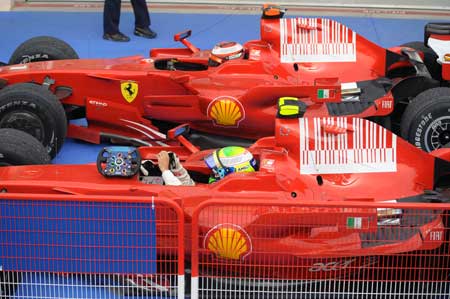
Felipe Massa and Kimi Räikkönen.
Felipe Massa made sure that there was not going to be any negative press in this week’s Gazzetta della Sport, and that he really is worth everything that Marlboro is subsidizing the Scuderia for his services this year.
[Read more…] about Bahrain Grand Prix
Much Less Guessin’ in Essen
Thanks to our readers we’ve determined the identities of the cars at Essen in last week’s VeloceToday, as well as some thoughts and experiences regarding painted Webers. Still, we could use more information on that Fiat single seater!!.
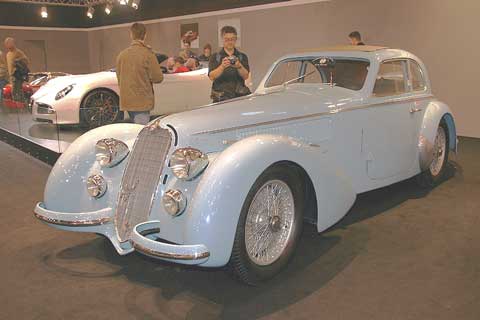
8C2900 photographed at Essen by Vanhoolandt Hugues .
London Encounters
Alessandro Gerelli in London.
A good photographer (what I am not) always brings along a photo machine when walking around in a city, watching here and there for any kind of subjects.
This weekend I was in London for a pop music concert and I had with me my photo tools: I have brought back three images that may interest our readers.
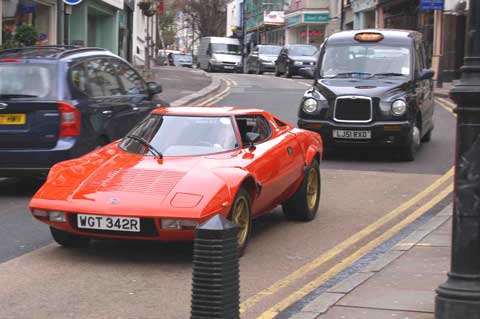
The first is a picture of a Lancia Stratos Stradale: what a small beauty ! No Aston, Bentley or Porsche may compete!
Deutsch-Bonnet at Sebring Part I
A Franco-American Love Story
By Philippe Defechereux © 2008
This is the tale of a long love affair spanning two generations and reaching across the Atlantic Ocean. The object of love is a little French racer (photo below) made by Deutsch-Bonnet, a manufacturer of highly successful small-bore racing cars that reigned supreme in their class between 1952 and 1962 from Le Mans to Sebring, FL.
Deutsch-Bonnet at Sebring Part II
Franco-American Love Story
By Philippe Defechereux © 2008
To read Part I, click here.
To read Part III, click here.
Our tale of the extraordinary love affair between a small French car maker, Deutsch-Bonnet, and an American father-son pair, tied to the birth and future success of the Sebring Twelve-Hours, continues in this issue.
Deutsch-Bonnet at Sebring Part III
Franco-American Love Story
By Philippe Defechereux © 2008
To read Part I, click here.
To read Part II, click here.
Our tale of the extraordinary love affair between a small French car maker, Deutsch-Bonnet, and an American father-son pair, tied to the birth and future success of the Sebring Twelve-Hours, concludes in this issue.
Werner Pfister at Cavallino
This year marked the 17th annual Ferrari event in Palm Beach hosted by John and Alicia Barnes. Entitled “A Convention of Ferrari Owners and Enthusiasts…†it delivered as promised with even more things to do this year than during any of the previous sixteen.
[Read more…] about Werner Pfister at Cavallino
The Alpine A110
By Pete Vack
On one hand, there is nothing quite so French as the Alpine.
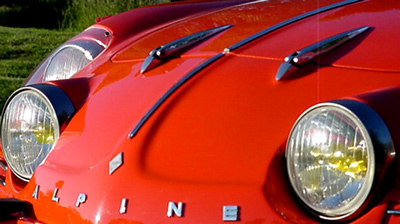
The Alpine A110
On the other, there is something about the Alpine that lures the Italian car enthusiast to the make, yet not quite sure of what to think of it. Perhaps a sort of a French Abarth; tiny, with a light, tight attractive body, a superb overall design hiding or at least diminishing the prominent proprietary power plant hanging well south of the rear axle, an affectation most notably best-conceived for the Simca Abarths or perhaps the 1000 Monomille.
[Read more…] about The Alpine A110
The Fate of D.B. and Panhard
Following up on the acclaimed history of D.B. at Sebring,
Philippe Defechereux tells us what became of the French Legends.
By Philippe Defechereux Copyright 2008
What Happened to Deutsch-Bonnet ?
Early in 1962, a partnership that had lasted over twenty years and won so many laurels came apart. Charles Deutsch found out that in December of 1961, René Bonnet had signed a secret agreement to drive for Renault; he would lead a Renault-backed team at the 1962 Le Mans 24-Hours; the cars would be called “René Bonnets.†When Charles Deutsch made Panhard aware of that, they were incensed. Quickly, they hired the betrayed engineer to put together a team of five cars, to be called “C.D. Panhards.†The clear goal was to beat Equipe René Bonnet at Le Mans that very year. The Deutsch-Bonnet company, which from the earliest days had been founded on the basis of verbal agreements and handshakes, was effectively no more. As footnote, the C.D. Panhards beat the René Bonnets fair and square at the 1962 Le Mans race, winning both the Index of Performance and the 850cc class.